

Motorcycle accidents frequently result in life-altering injuries because riders lack the structural protection that passenger vehicles provide. In my experience representing injured motorcyclists, the legal and insurance challenges following a crash are often just as serious as the physical injuries. Insurance companies may dispute liability, question injury severity, or attempt to shift blame onto the rider. This guide is written to provide accurate, experience-based legal insight into what to do after a crash, how accidents commonly occur, and the types of injuries that most often arise in motorcycle accident claims.
Quick Overview:
This comprehensive guide to motorcycle accidents and injuries, written by a personal injury attorney, explains what to do after a crash, how motorcycle accidents commonly occur, and the serious injuries riders often face. It covers how fault is determined, why insurance companies may challenge claims, how settlements are calculated, and what legal options are available, providing practical, experience-based guidance to help injured riders protect their rights and pursue full compensation.
What to Do Immediately After a Motorcycle Accident
The steps taken in the first minutes and days after a motorcycle accident can directly impact both medical recovery and the strength of a personal injury claim. Evidence disappears quickly, and early missteps can reduce compensation.
Step-by-Step Actions at the Scene
- Call 911 and request both police and medical responders. An official accident report creates an objective record of the crash and often becomes central evidence if liability is disputed.
- Accept medical evaluation, even if you feel stable. Adrenaline can mask symptoms of concussions, internal bleeding, or spinal injuries. Prompt treatment protects both your health and your legal claim.
- Move to safety if physically able, but avoid unnecessary movement if you suspect neck or spinal injuries. Secondary collisions are common in roadway crashes.
- Avoid admitting fault or speculating about what happened. Even a casual apology can later be construed as an admission of liability. Provide factual information to law enforcement without guessing.
- Exchange identifying and insurance information with all involved drivers and obtain contact information from any witnesses. Independent witness testimony can be decisive in contested cases.
Evidence You Must Preserve
Motorcycle accident claims are highly dependent on physical and digital evidence. Early documentation often strengthens negotiating leverage.
- Photograph the entire scene, including vehicle damage, skid marks, roadway conditions, traffic signals, and visible injuries. Wide-angle and close-up images are both important.
- Preserve your motorcycle and protective gear in their damaged condition. Helmets, jackets, and other gear can demonstrate the severity and mechanics of impact.
- Obtain a copy of the police report as soon as it becomes available and review it for factual accuracy. If errors exist, request clarification or correction promptly.
- Identify potential surveillance footage from nearby businesses or traffic cameras. This footage is often erased within days unless preserved.
What If You Are Too Injured to Act?
In serious motorcycle crashes, riders are frequently transported immediately for emergency treatment. When that occurs:
- Law enforcement typically documents scene measurements and driver statements.
- Emergency medical records establish early injury documentation.
- An attorney can initiate an independent investigation, send preservation letters for video footage, and retain accident reconstruction experts if liability is disputed.
Early legal involvement is often critical in high-injury motorcycle cases.
Common Causes of Motorcycle Accidents
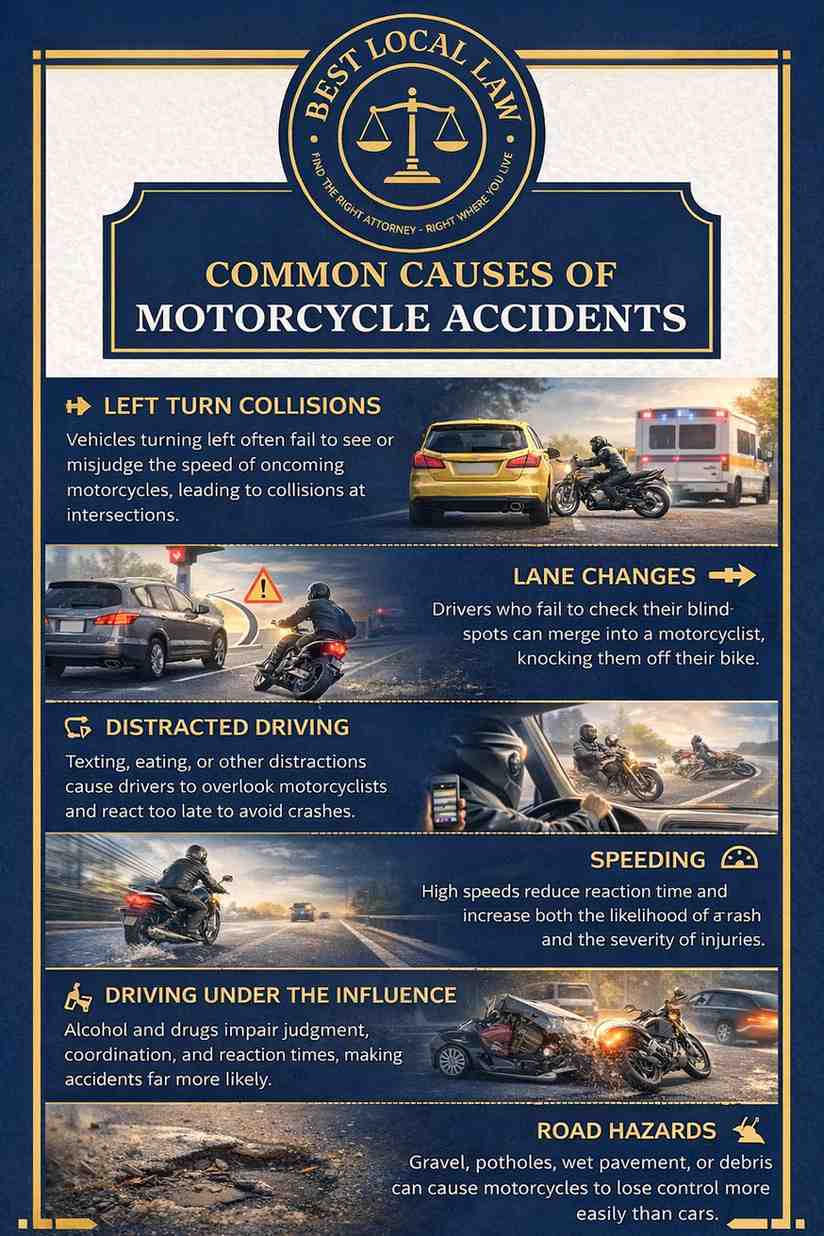
Most motorcycle accident claims arise from driver negligence rather than rider error. A recurring theme in litigation is that drivers fail to see or properly account for motorcycles in traffic.
Left-Turn Collisions
Left-turn accidents are among the most common motorcycle crash scenarios. A vehicle turns in front of an oncoming motorcycle after misjudging its speed or failing to see it entirely. These crashes frequently occur at intersections and often result in severe frontal impact injuries.
Unsafe Lane Changes
Motorcycles are more difficult to detect in blind spots. Drivers who fail to check mirrors, signal properly, or perform shoulder checks may sideswipe or force a rider off the road. Heavy highway traffic increases this risk.
Distracted and Aggressive Driving
Distracted driving, including texting, navigation use, or adjusting in-vehicle systems, remains a leading cause of crashes. Reduced reaction time is particularly dangerous when sharing the road with motorcycles.
Aggressive driving behaviors such as tailgating, unsafe passing, and speeding also contribute significantly to high-impact collisions involving riders.
Impaired Driving
Drivers under the influence of alcohol or drugs exhibit delayed reflexes and poor judgment. Motorcycle crashes involving impaired drivers often result in catastrophic injuries and may support claims for punitive damages depending on the jurisdiction.
Roadway Hazards and External Factors
Motorcycles are more sensitive to road defects than passenger vehicles. Potholes, loose gravel, uneven pavement, and construction debris can destabilize a bike. In certain cases, government entities or contractors may share liability for unsafe roadway conditions.
Mechanical failures—such as brake defects or tire blowouts—may also contribute to crashes and can give rise to product liability claims.
Most Common Motorcycle Accident Injuries
Because riders lack protective barriers, motorcycle accident injuries are often severe and long-lasting. Injury severity directly influences case valuation, long-term medical costs, and loss of earning capacity.
Traumatic Brain Injuries
Traumatic brain injuries range from concussions to permanent cognitive impairment. Even helmeted riders can suffer brain trauma due to forceful impact. Symptoms may include memory loss, confusion, mood changes, and chronic headaches. Severe TBIs may require long-term neurological care and significantly affect quality of life.
Spinal Cord Injuries
Spinal trauma can result in herniated discs, nerve damage, partial paralysis, or complete paralysis. These injuries often require surgery, extensive rehabilitation, and long-term assistive devices. The lifetime financial impact of spinal cord injuries can be substantial.
Road Rash and Soft Tissue Damage
Road rash occurs when skin makes direct contact with pavement during a slide. While minor cases may heal with minimal intervention, severe cases can involve deep tissue damage, infection risk, nerve injury, and permanent scarring. In high-impact crashes, skin graft procedures may be required.
Fractures and Orthopedic Injuries
Broken bones are common in motorcycle crashes, particularly involving the legs, arms, collarbone, and ribs. Complex fractures may require surgical repair with hardware implantation and extended physical therapy. Recovery time can significantly impact a rider’s ability to work.
Internal Injuries and Amputations
Blunt force trauma can cause internal bleeding or organ damage that is not immediately visible. These injuries may require emergency surgery and can be life-threatening.
In severe crashes, traumatic amputations or surgical limb removal may occur. These injuries involve permanent disability, prosthetic use, psychological trauma, and long-term economic consequences.
Psychological Trauma
Motorcycle accident survivors frequently experience emotional injuries such as post-traumatic stress disorder (PTSD), anxiety, depression, and sleep disturbances. Mental health treatment is a legitimate component of a personal injury claim and should not be overlooked.
These first three sections establish the foundation of a strong motorcycle accident claim: immediate protective steps, understanding how crashes occur, and recognizing the severity of potential injuries. Subsequent sections will address liability disputes, insurance company tactics, and the calculation of settlement values.
Why Motorcycle Accident Claims Are Often More Challenging
Motorcycle accident cases frequently involve more resistance from insurance companies than standard auto accident claims. As a personal injury attorney, I have seen consistent patterns of bias, aggressive defense tactics, and attempts to minimize injury severity. Understanding these challenges helps injured riders protect their rights early.
Insurance Bias Against Motorcyclists
Insurance carriers often rely on stereotypes that portray riders as reckless or risk-seeking. These assumptions can influence how adjusters evaluate claims. Common tactics include:
- Arguing the rider was speeding without clear evidence
• Suggesting the rider was lane splitting improperly (even in states where it is legal)
• Claiming the rider “came out of nowhere.”
• Minimizing visibility issues that should have been the driver’s responsibility
Overcoming bias requires strong evidence, clear accident reconstruction, and thorough documentation of injuries.
Comparative or Contributory Negligence Laws
Many states apply comparative negligence rules, meaning compensation may be reduced if the injured rider is found partially at fault. In some jurisdictions, recovery may be barred entirely if fault exceeds a certain percentage.
Insurance companies often attempt to assign partial blame by arguing:
- The rider was traveling above the speed limit
• The rider failed to take evasive action
• The rider’s clothing reduced visibility
• The rider was not using proper safety equipment
Understanding your state’s fault rules is critical because even small percentages of alleged fault can significantly affect settlement value.
Helmet Laws and Injury Arguments
Helmet laws vary by state. Even in states without universal helmet requirements, insurance companies may attempt to argue that failure to wear a helmet contributed to the severity of injuries, particularly in traumatic brain injury claims.
However, the legal question is typically whether the lack of a helmet caused or worsened a specific injury, not whether it caused the accident itself. Courts often require medical and biomechanical evidence to support such arguments.
Limited Insurance Coverage Issues
Motorcycle accidents frequently involve high medical expenses that exceed minimum insurance policy limits. Challenges may include:
- Drivers carrying only minimum liability coverage
• Uninsured or underinsured motorists
• Disputes involving stacked insurance policies
• Complex coordination between multiple carriers
Identifying all available insurance coverage early in the case is often essential to maximizing recovery.
How Fault Is Determined in a Motorcycle Accident
Establishing liability is the foundation of any successful motorcycle accident claim. While police reports are important, they are only one piece of the overall evidentiary picture.
Police Investigation and Crash Reports
Officers typically document:
- Statements from drivers and witnesses
• Vehicle positioning
• Visible damage
• Traffic citations issued
• Environmental conditions
Although police reports carry weight, they are not final determinations of fault. If errors or incomplete conclusions exist, they can be challenged with additional evidence.
Eyewitness Testimony
Independent witnesses often play a critical role in resolving liability disputes. Neutral third-party observations can counter biased statements by drivers.
Promptly locating and interviewing witnesses strengthens credibility and preserves details while memories are fresh.
Physical and Digital Evidence
Modern accident investigations frequently rely on technology. This may include:
- Traffic camera footage
• Nearby business surveillance video
• Dashcam recordings
• Event data recorders (vehicle “black box” systems)
• GPS or ride tracking data
This evidence can confirm speed, braking patterns, and traffic signal phases at the time of impact.
Accident Reconstruction Experts
In serious injury cases, accident reconstruction specialists analyze vehicle damage, skid marks, and impact angles to determine how the collision occurred. Their findings can rebut inaccurate driver narratives and strengthen leverage in negotiations or at trial.
How Motorcycle Accident Settlements Are Calculated
Documented damages and provable liability drive motorcycle accident settlements. Severe injury cases often involve both substantial economic losses and significant non-economic harm.
Economic Damages
Economic damages represent measurable financial losses, including:
- Past medical bills
• Future medical treatment and rehabilitation
• Lost wages during recovery
• Loss of future earning capacity
• Property damage to the motorcycle
• Out-of-pocket expenses related to care
Future damages are often calculated using medical expert opinions and, in high-value cases, life care planning professionals.
Non-Economic Damages
Non-economic damages compensate for the human impact of an injury. These may include:
- Physical pain and suffering
• Emotional distress
• Disfigurement and scarring
• Loss of enjoyment of life
• Loss of consortium (in some cases)
Because motorcycle injuries are frequently severe, non-economic damages can represent a substantial portion of total settlement value.
Punitive Damages
In cases involving egregious misconduct, such as drunk driving or extreme recklessness, punitive damages may be available in certain jurisdictions. These damages are intended to punish particularly dangerous behavior rather than compensate the injured party.
How Insurance Companies Evaluate Settlement Offers
Insurance adjusters typically consider:
- Clarity of liability
• Severity and permanence of injuries
• Total medical costs
• Impact on earning capacity
• Jury verdict trends in the jurisdiction
• Credibility of the injured rider
Early low settlement offers are common, particularly before the full extent of injuries is known. Accepting an early offer can permanently waive the right to pursue additional compensation.
Do I Have a Case? A Practical Self-Assessment
Many injured riders are unsure whether they have a viable personal injury claim. While every case is unique, several core questions help determine legal viability.
You may have a strong motorcycle accident case if:
- Another party acted negligently or violated traffic laws
• You sustained documented physical injuries
• The accident caused financial losses
• There is available insurance coverage
• You are within your state’s statute of limitations
Even if you believe you may have been partially at fault, you may still be entitled to compensation under comparative negligence laws. Early legal evaluation often clarifies claim strength and prevents costly procedural mistakes.
These sections address the legal complexity behind motorcycle accident litigation, from insurance bias to damage calculation. The next sections will examine wrongful death claims, address dealings with insurance adjusters, and explain how an experienced motorcycle accident attorney builds and presents a high-value case.
What If the Other Driver Lies?
It is not uncommon for drivers to change their story after a motorcycle accident, especially when they realize the severity of the rider’s injuries. In serious cases, the at-fault driver may deny running a red light, claim the rider was speeding, or assert that the motorcycle was weaving through traffic. These disputes can significantly affect settlement negotiations if not properly addressed.
Common False Claims Drivers Make
Drivers and their insurers may argue:
- “The motorcycle came out of nowhere.”
• “The rider was speeding.”
• “The rider was lane splitting illegally.”
• “The rider lost control.”
• “I had the green light.”
These statements are often made without objective proof and may conflict with physical evidence or witness accounts.

How False Narratives Are Challenged
When a fault is disputed, strong evidence becomes critical. This may include:
- Traffic camera or surveillance footage
• Event data recorder (black box) downloads
• Skid mark and vehicle damage analysis
• Eyewitness testimony
• Cell phone usage records in distracted driving cases
Accident reconstruction experts can scientifically analyze impact angles, crush patterns, and stopping distances to refute inaccurate driver accounts.
Protecting Your Credibility
Insurance companies assess credibility closely. To protect your claim:
- Provide consistent statements
• Avoid posting about the accident on social media
• Do not exaggerate injuries
• Follow medical treatment recommendations
A well-documented case supported by objective evidence is often the most effective way to counter false accusations.
What If You Weren’t Wearing a Helmet?
Helmet use is a common issue raised in motorcycle accident litigation. Laws vary by state, with some requiring helmets for all riders and others limiting requirements based on age or insurance coverage.
Does Not Wearing a Helmet Prevent Recovery?
In most jurisdictions, failure to wear a helmet does not automatically bar recovery. The key legal question is whether the lack of a helmet contributed to the severity of a specific injury.
For example:
- If the rider suffered a broken leg, helmet use may be irrelevant.
• If the rider sustained a traumatic brain injury, the defense may argue that helmet use would have reduced severity.
Even then, the burden typically falls on the defense to prove that helmet use would have materially changed the injury outcome.
Comparative Fault Considerations
In states applying comparative negligence rules, compensation may be reduced if the injured rider is found partially responsible for worsening their injuries. However, this reduction generally applies only to the injury affected, not the entire claim.
Each case depends heavily on medical testimony and biomechanical analysis. Riders should not assume they have no case simply because they were not wearing a helmet.
Motorcycle Accident Lawsuit Timeline
While many motorcycle accident claims settle before trial, understanding the litigation process provides clarity and realistic expectations. Serious injury cases often require formal legal action to achieve full compensation.
Investigation and Pre-Suit Phase
During this stage:
- Medical treatment progresses
• Evidence is gathered and preserved
• Insurance coverage is identified
• Liability is analyzed
• Demand packages are prepared
This phase may last several months, depending on the severity of the injury and the progress of recovery.
Filing the Lawsuit
If negotiations stall or liability is denied, a formal complaint is filed in court. The defendant is served, and the litigation process begins. Filing does not mean the case will necessarily go to trial—it often increases negotiation leverage.
Discovery Phase
Discovery is the formal exchange of evidence between parties. It may involve:
- Written interrogatories
• Requests for document production
• Depositions of drivers, witnesses, and medical providers
• Independent medical examinations requested by the defense
This stage is critical for clarifying disputed facts and evaluating the strength of the case.
Mediation and Settlement Negotiations
Courts often require mediation before trial. A neutral mediator facilitates settlement discussions. Many motorcycle accident cases resolve during or shortly after mediation, once both parties understand the litigation risk.
Trial
If a settlement cannot be reached, the case proceeds to trial. A judge or jury determines liability and damages. While trials involve risk, they may be necessary when insurers refuse to offer fair compensation.
Wrongful Death Motorcycle Claims
Tragically, motorcycle accidents result in a disproportionate number of roadway fatalities. When a rider loses their life due to another party’s negligence, surviving family members may have the right to pursue a wrongful death claim.
Who Can File a Wrongful Death Claim?
Eligibility varies by state but often includes:
- Surviving spouse
• Children
• Parents (in certain circumstances)
• Court-appointed representatives of the estate
State statutes strictly define who may bring the claim and within what timeframe.
Damages Available in Wrongful Death Cases
Compensation in wrongful death claims may include:
- Funeral and burial expenses
• Medical expenses incurred before death
• Loss of financial support
• Loss of companionship and guidance
• Emotional suffering of surviving family members
In some jurisdictions, punitive damages may be available if the at-fault party’s conduct was especially reckless, such as driving under the influence.
Statute of Limitations Considerations
Wrongful death claims are subject to strict filing deadlines. Missing the statute of limitations can permanently bar recovery, regardless of the strength of the case. Early legal consultation is essential in fatal motorcycle accident cases.
These sections address some of the most complex and emotionally charged aspects of motorcycle accident litigation, including disputed liability, helmet defenses, formal lawsuits, and fatal crashes. The next sections will examine how to deal directly with insurance adjusters and how an experienced motorcycle accident attorney builds a strong, evidence-driven case for maximum compensation.
Dealing With Insurance Adjusters After a Motorcycle Accident
After a motorcycle accident, insurance companies begin working immediately to protect their financial interests. Adjusters are trained negotiators whose goal is to limit payouts. Understanding how these interactions work can prevent costly mistakes.
The Early Contact Strategy
Shortly after the crash, you may receive a phone call requesting a recorded statement. The adjuster may appear friendly and concerned, but the purpose of the call is often to obtain information that may reduce the claim’s value.
Common tactics include:
- Asking leading questions about speed or visibility
• Requesting speculation about what you “could have done differently.”
• Locking you into a version of events before all facts are known
• Minimizing the seriousness of your injuries
You are generally not required to provide a recorded statement to the other driver’s insurance company without legal guidance.
Quick Settlement Offers
In cases involving visible injuries or emergency treatment, insurers sometimes make early settlement offers before the full medical picture is clear. These offers may seem substantial at first, but often fail to account for:
- Future surgeries
• Long-term rehabilitation
• Ongoing pain management
• Lost earning capacity
• Permanent disability
Once a settlement release is signed, you typically cannot reopen the claim—even if complications arise later.
Social Media and Surveillance
Insurance companies frequently monitor social media accounts and, in high-value cases, may conduct surveillance. Innocent posts or photos taken out of context can be used to challenge injury claims.
To protect your case:
- Avoid posting about the accident or your recovery
• Refrain from discussing physical activity online
• Follow medical restrictions carefully
Why Legal Representation Changes the Dynamic
When an experienced motorcycle accident attorney becomes involved:
- Communication with insurers shifts to formal channels
• Deadlines and documentation requests are properly managed
• Settlement demands are supported with medical and economic evidence
• Low offers are evaluated against jury verdict trends
Insurance carriers typically reassess exposure when they know the injured rider is prepared to litigate if necessary.
How a Motorcycle Accident Attorney Builds a Strong Case
Motorcycle accident litigation requires more than submitting medical bills. High-value claims are built through detailed investigation, strategic documentation, and careful calculation of damages.
Independent Investigation
An attorney may:
- Visit the accident scene
• Secure surveillance footage
• Retain accident reconstruction specialists
• Interview witnesses
• Preserve physical evidence
Early investigation often prevents the loss of critical proof.
Medical Documentation and Expert Support
Serious motorcycle injury cases frequently require expert testimony to establish:
- Causation between the crash and injuries
• Future medical needs
• Long-term disability
• Permanent impairment ratings
In complex cases, attorneys may work with life care planners and vocational experts to project future financial losses.
Calculating Full Damages
A thorough case evaluation considers:
- Total past medical expenses
• Anticipated future treatment costs
• Lost income and diminished earning capacity
• Pain and suffering
• Loss of enjoyment of life
• Emotional distress
Many injured riders underestimate the long-term financial impact of their injuries. A comprehensive damages analysis ensures that settlement negotiations reflect the true value of the claim.
Trial Preparation as Leverage
Even when settlement is the goal, preparing a case as if it will go to trial strengthens negotiating power. Insurance companies track which attorneys consistently take cases to verdict. A reputation for readiness often increases settlement offers.
Contingency Fee Representation
Most motorcycle accident attorneys work on a contingency fee basis, meaning:
- No upfront legal fees
• Fees are paid only if compensation is recovered
• Access to legal representation regardless of immediate financial strain
This structure aligns the attorney’s incentive with maximizing recovery for the injured rider.
Motorcycle Accident Statistics in the United States
Motorcycle riders represent a disproportionately high percentage of roadway fatalities compared to passenger vehicle occupants. National transportation safety data consistently shows:
- Motorcyclists face a significantly higher fatality rate per mile traveled
• Head injuries are among the leading causes of death in motorcycle crashes
• A substantial portion of fatal crashes involve another vehicle turning or failing to yield
• Alcohol impairment remains a contributing factor in a notable percentage of fatal incidents
• Urban intersections and rural highways both present elevated risks
These statistics underscore the seriousness of motorcycle collisions and reinforce the importance of proper legal representation in severe injury cases.
Mistakes to Avoid After a Motorcycle Crash
Even strong cases can be weakened by avoidable missteps. Based on litigation experience, the following mistakes frequently reduce claim value:
- Delaying medical treatment or failing to follow doctor recommendations
• Providing recorded statements without preparation
• Accepting early settlement offers before maximum medical improvement
• Posting accident details on social media
• Failing to preserve damaged equipment
• Missing the statute of limitations deadline
Avoiding these mistakes preserves both credibility and leverage during negotiations.
Frequently Asked Questions About Motorcycle Accident Claims
Below are 11 of the most common questions injured riders ask when considering a motorcycle accident claim.
- How long do I have to file a motorcycle accident claim?
Each state has a statute of limitations that sets a strict deadline for filing a lawsuit. In many states, this period ranges from one to three years from the date of the accident, though exceptions may apply in cases involving government entities or minors. Missing the deadline typically prevents you from recovering compensation. - Can I recover compensation if I was partially at fault?
In most states, yes. Under comparative negligence rules, your compensation may be reduced by your percentage of fault. For example, if you are found 20% responsible, your recovery may be reduced by 20%. Some states bar recovery if your fault exceeds a certain threshold. - What if the driver who hit me does not have insurance?
If the at-fault driver is uninsured or underinsured, you may be able to file a claim under your own uninsured/underinsured motorist (UM/UIM) coverage, depending on your policy terms. Reviewing your insurance coverage is critical in these situations. - How much is my motorcycle accident case worth?
Case value depends on several factors, including the severity of injuries, medical expenses, lost income, long-term disability, pain and suffering, and available insurance coverage. There is no universal formula, and each case must be evaluated individually. - How long does a motorcycle accident settlement take?
The timeline varies depending on the severity of the injury and whether a lawsuit is required. Cases involving serious or permanent injuries may take longer because it is important to understand the full medical picture before negotiating a final settlement. - Will my case go to trial?
Most motorcycle accident cases settle before trial. However, filing a lawsuit may be necessary if the insurance company disputes liability or refuses to offer fair compensation. Trial preparation often strengthens settlement negotiations. - What damages can I recover after a motorcycle accident?
You may be entitled to economic damages such as medical bills and lost wages, as well as non-economic damages like pain and suffering, emotional distress, and loss of enjoyment of life. In some cases, punitive damages may also be available. - What if I wasn’t wearing a helmet?
Not wearing a helmet does not automatically prevent recovery. The key issue is whether the lack of a helmet contributed to the severity of specific injuries. Compensation may be adjusted in some cases, but you may still have a valid claim. - Should I give a recorded statement to the insurance company?
You are generally not required to provide a recorded statement to the other driver’s insurer without legal guidance. Recorded statements can be used to minimize or challenge your claim, so it is wise to proceed cautiously. - What if the other driver is blaming me for the accident?
Fault disputes are common in motorcycle accident cases. Evidence such as witness testimony, traffic camera footage, vehicle data, and accident reconstruction analysis can help determine what truly happened. Do not assume you lack a case simply because the other driver denies responsibility. - Do I really need a motorcycle accident attorney?
While you are not legally required to hire an attorney, serious motorcycle accident claims often involve complex liability issues, significant damages, and aggressive insurance tactics. Experienced legal representation can help protect your rights and pursue the full compensation available under the law.
Conclusion — Protecting Your Rights After a Motorcycle Accident
Motorcycle accidents are rarely minor events. The injuries are often severe, the financial consequences significant, and the insurance disputes aggressive. Early decision-seeking medical care, preserving evidence, and obtaining legal guidance can dramatically influence the outcome of your claim.
If you or a loved one has been injured in a motorcycle accident, understanding your rights is the first step toward recovery. A thorough investigation, proper documentation of damages, and strategic negotiation are essential to securing fair compensation.
An experienced motorcycle accident attorney can evaluate liability, identify all available insurance coverage, and pursue the full value of your claim—whether through settlement or trial.