

An arrest is not just a bad day; it can be a legal event with consequences that ripple for years. In my work as a criminal defense attorney, I see the same pattern repeatedly: people do not lose cases only because of what they are accused of; they often lose leverage because of what happens immediately after police contact. A single statement, a “helpful” explanation, a consent to search, or a casual jail phone call can create evidence the prosecution did not have before.
This is a pillar-page resource designed to answer the questions people search most often when they (or someone they love) are dealing with an arrest, police questioning, or criminal charges in the U.S. It explains what criminal law is, how arrests work, what to do if you’re questioned, how courts process criminal cases, how bail and plea bargaining fit in, what the Constitution protects, how real crime statistics help contextualize common charges, and why experienced defense representation matters early.
What to find in the Guide: Quick Overview
This pillar guide explains arrests and criminal law in the United States from initial police contact through the court process. It covers what to do if arrested, how to handle questioning, how charges are classified, how probable cause and warrants work, what happens in booking and bail, how cases move through arraignment, motions, plea negotiations, trial, and sentencing, and what constitutional rights protect you. It includes real U.S. crime and incarceration statistics, explains the long-term consequences of a criminal record, and provides practical defense strategy guidance from a criminal defense attorney.
Criminal Law Basics
Criminal law is the set of rules that defines conduct that the government prohibits and punishes. A criminal case is brought by the government (state or federal) against an individual accused of violating a criminal statute. This matters because the government has investigative tools that private parties do not—law enforcement agencies, subpoenas, search warrants, forensic labs, and prosecutors dedicated to proving guilt.
Criminal cases can result in penalties such as incarceration, probation, fines, court-ordered treatment, and restrictions on where you can live, work, or travel. Just as important, criminal cases can create collateral consequences: outcomes that follow you beyond the courtroom, like employment barriers, housing denials, professional license problems, and immigration consequences.
The presumption of innocence and burden of proof
The legal system is designed around the presumption of innocence. The prosecution must prove guilt beyond a reasonable doubt. In real terms, that means:
- You do not have to “prove your innocence.” The burden stays on the government.
- The prosecution must present evidence that convinces a judge or jury to a very high level of certainty.
- If there is a reasonable doubt—rooted in logic and evidence—the verdict should be not guilty.
That said, what people do not realize is that your actions right after police contact can supply the prosecution with the evidence it needs to meet that burden.
Criminal vs. civil cases
People often confuse criminal cases with civil lawsuits. Civil cases typically involve private parties seeking money damages or court orders, and the proof standard is lower (“more likely than not”). Criminal cases can take your freedom, and the standard is much higher, but the consequences can be far more severe.
State vs. federal criminal law
Most prosecutions in the U.S. happen in state court for offenses like DUI, assault, theft, and many drug charges. Federal cases generally involve federal jurisdiction (for example, offenses crossing state lines, crimes on federal property, certain firearms cases, federal drug trafficking, large-scale fraud, or immigration-related offenses). Federal procedure and sentencing can be more rigid, and federal investigations often build slowly and thoroughly before charges are filed.
Understanding Criminal Charges
A pillar-page resource has to do more than define “misdemeanor vs felony.” It should explain why the charge level matters and how prosecutors and judges treat different case categories.
Infractions and minor violations
Infractions are low-level offenses—often traffic or municipal code issues—typically punished with fines. But infractions still matter because they can snowball when ignored. The most common way an “infraction problem” becomes a “criminal problem” is failure to appear (missing court) or license-related consequences that lead to additional charges later.
When someone gets cited for an infraction, the practical risks are:
- Missing a deadline and triggering a warrant or additional penalties
- Losing driving privileges (which can then lead to driving-while-suspended charges)
- Creating a record that later affects insurance rates or employment screening in driving-related jobs
Misdemeanors
Misdemeanors are criminal offenses that may carry jail exposure (often up to one year in many jurisdictions, depending on the statute and local rules). Examples commonly include: first-offense DUI in many places, simple assault, petty theft, disorderly conduct, trespass, and certain domestic violence-related allegations.
Misdemeanor cases can look “small” on paper, but they create real risk because:
- A conviction often becomes a permanent record that appears on background checks
- Probation conditions can be strict and easy to violate
- Protective orders/no-contact orders can disrupt family and housing arrangements
- A plea can trigger immigration issues for non-citizens (even when jail time is avoided)
Felonies
Felonies are more serious charges with potential prison exposure. Examples commonly include aggravated assault, robbery, burglary of a dwelling, serious drug distribution allegations, major fraud schemes, and homicide-related offenses.
Felony cases differ from misdemeanors in ways that affect strategy:
- Prosecutors often file higher charges early and negotiate down later, depending on the evidence
- Investigations tend to involve more forensics, digital evidence, or expert testimony
- Bail is often higher, and detention risk is greater
- Collateral consequences can be harsher (firearms restrictions, licensing bans, employment barriers)
Categories that drive “most searched” criminal law topics
Even without getting state-specific, most criminal law searches fall into several major categories:
- DUI and driving-related crimes (DUI, reckless driving, driving while suspended, hit-and-run)
- Assault and interpersonal violence allegations (including domestic violence-related charges)
- Theft/property crimes (shoplifting, burglary, fraud-related theft)
- Drug offenses (possession, possession with intent, trafficking, paraphernalia)
- Weapons/firearms charges (unlawful possession, use in commission of a crime)
- White collar offenses (wire fraud, identity theft, embezzlement, forgery)
These categories matter because courts, prosecutors, and probation departments often have standardized “paths” for them—mandatory classes, evaluation requirements, diversion eligibility, and sentencing patterns. A good defense strategy anticipates those paths early.
The Criminal Arrest Process
An arrest is a legal seizure of a person. It usually starts with probable cause and ends with custody, booking, and a first court appearance. Understanding the process helps you identify where rights violations occur—and where defense attorneys can attack the case.
Probable cause
Probable cause is the legal standard officers must have to arrest someone (or to seek an arrest warrant). It is not proof beyond a reasonable doubt. It is a lower threshold based on facts and circumstances that would lead a reasonable person to believe a crime occurred and the person arrested committed it.
Where probable cause comes from in real cases:
- Officer observations (what the officer claims they saw, smelled, or heard)
- Witness statements (including alleged victims and bystanders)
- Physical evidence (injuries, weapons, drugs, damaged property)
- Digital evidence (videos, texts, social media posts, location data)
- Admissions (statements you make—sometimes trying to “clear it up”)
Probable cause is often litigated through suppression motions when an arrest stems from unlawful stops, unreliable identifications, or unconstitutional searches.
Warrants vs. warrantless arrests
Arrests can occur with a warrant (a judge has signed off on probable cause) or without one (typically when police observe conduct, respond to a scene, or believe immediate action is necessary). Warrants matter because they often reflect longer investigations, and they can involve additional search warrants for phones, homes, cars, and digital accounts.
Search incident to arrest
After a lawful arrest, police can typically search the person and areas within immediate reach to ensure officer safety and preserve evidence. This is one reason arrests can expand quickly: an arrest triggers a search, and a search can reveal additional alleged offenses. A defense attorney will examine whether the arrest was lawful and whether the search stayed within legal limits.
Miranda warnings
Miranda warnings apply when you are in custody and subjected to interrogation. If police question you in a custodial setting without proper Miranda advisement, certain statements may be suppressible. But do not assume Miranda is a “shield” that will automatically protect you—many damaging statements happen before Miranda is required, during casual conversation, or during “voluntary” interviews.
Booking and the first hours of custody
Booking typically involves identification, fingerprints, photographs, property inventory, and entry of charges. Many people underestimate how evidence is created at this stage: recorded calls, recorded interviews, officer reports, and, in some cases, medical or intoxication documentation.
What To Do if You Are Arrested
This is the part people need most, and it must be practical—not slogans. The goal is to protect your defense position from day one.
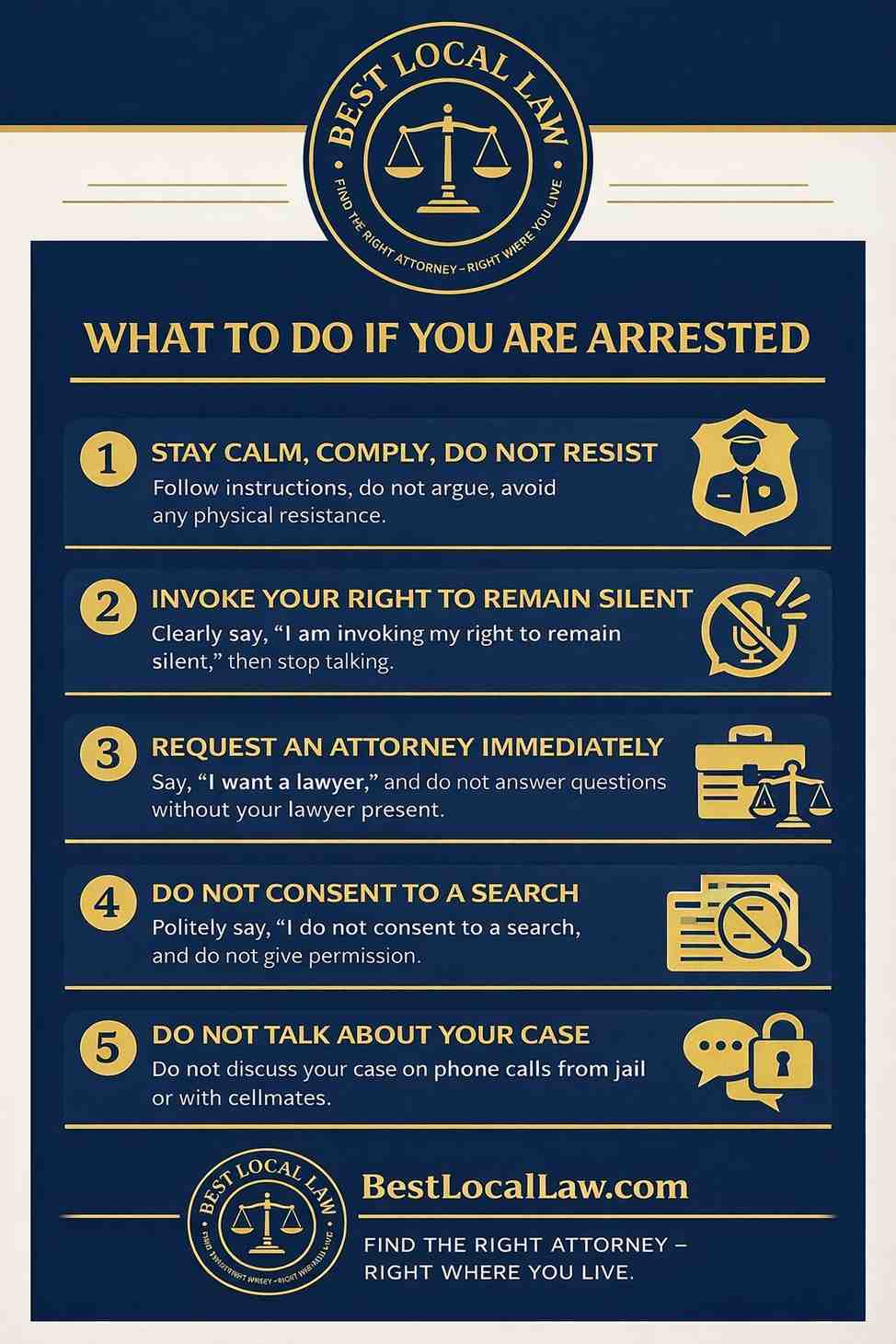
If you are arrested, the most effective legal posture is simple: comply physically, clearly communicate your rights, and stop creating evidence.
Here is how that looks in real life:
1) Do not resist—physically or verbally
Resisting can lead to additional charges, justify the use of force, and complicate the bond. Even verbal escalation can be reframed as threats or obstruction. You can contest the arrest legally later; you cannot “win” it at the roadside.
2) Invoke silence the right way
Silence is not always automatically treated as an invocation. Use clear language:
“I am invoking my right to remain silent.”
Then stop talking. Do not answer follow-ups. Do not “explain just one thing.” The most damaging statements are often the ones people make after they think they have already invoked their rights.
3) Request counsel clearly
Say: “I want a lawyer.”
Then stop. If you keep talking, prosecutors may argue you voluntarily waived your rights. The safest approach is to request counsel and end the conversation.
4) Do not consent to searches
If asked, state: “I do not consent to a search.”
Police may still search under claimed exceptions or a warrant, but your lack of consent can preserve legal arguments later. Consent is one of the most common ways people unintentionally surrender defenses.
5) Do not discuss the case in custody
This is where many cases are lost. In custody:
- Calls are commonly recorded.
- Conversations with cellmates are not privileged and can become testimony.
- Messages through jail systems can be documented.
- “I shouldn’t have done that” statements become admissions.
6) Focus on accuracy with your attorney, not with the police
Your attorney’s job is to tell your story strategically, supported by evidence, and without creating new problems. Trying to do it yourself with the police usually backfires.
What To Do if the Police Question You
Many cases begin with “We just want your side” or “We’re trying to clear this up.” That framing is designed to obtain statements. Even when you are innocent, you can talk yourself into probable cause or create contradictions that prosecutors later use to attack credibility.
First question: Are you free to leave?
Ask: “Am I being detained, or am I free to go?”
- If you are free to go, leave politely.
- If you are detained, do not escalate. Invoke rights and stop answering questions.
Understand the difference between “friendly conversation” and interrogation.
Interrogation can look casual. Police may chat about your job, your family, or “what happened” to build rapport. But the purpose is often to lock you into details and gather admissions.
Common interrogation techniques that create false confidence
Police questioning frequently includes tactics such as:
- Minimization (“This isn’t a big deal—help me understand.”)
- False certainty (“We already know what happened.”)
- Evidence bluffing (“We have video/texts/witnesses.” even when they don’t)
- Moral framing (“The right thing is to tell the truth.”)
- Time pressure (“This is your only chance.”)
Because deception can be legally permitted in many contexts, the safest general rule is: do not answer substantive questions without counsel.
If the police come to your home
You generally do not have to let police inside without a warrant (there are exceptions, but the warrant question matters). You can say:
“I do not consent to entry or a search.”
If they present a warrant, comply and contact counsel immediately. Do not interfere physically—document details for your attorney (names, agency, what was taken, what was said).
How a Criminal Case Moves Through the Court
A pillar page should explain not just the “steps,” but why each step matters strategically.
Arraignment
Arraignment is typically where charges are formally read, and a plea is entered. For many defendants, the most important issue at arraignment is release: bail, conditions, no-contact orders, travel restrictions, or supervision requirements.
Defense posture at arraignment often focuses on:
- Preventing unnecessary detention
- Limiting restrictive conditions that can cause job or housing loss
- Preserving the ability to gather evidence and prepare a defense
Bail and pretrial release
Bail is supposed to ensure court appearance and protect public safety, not punish. But in practice, bail decisions can determine the outcome of a case because detained defendants face pressure to plead just to go home.
Discovery and investigation
Discovery is the process by which evidence is exchanged. This may include police reports, body-cam and dash-cam footage, witness statements, lab results, digital evidence, and prior records.
A defense attorney uses this phase to:
- Identify inconsistencies and missing evidence
- Locate defense witnesses
- Challenge identification reliability
- Retain experts when necessary
- Build a timeline that undermines the prosecution’s narrative
Motions practice (where cases can be won early)
Many strong defenses arise from motions—especially motions to suppress evidence arising from unconstitutional stops, searches, seizures, or interrogations. If key evidence is suppressed, prosecutors often reduce charges or dismiss cases.
Plea negotiations
Plea bargaining is common in U.S. criminal courts, but it is not simply “take it or go to trial.” A good defense negotiation is evidence-driven: it leverages weaknesses in the case, mitigation, and litigation risk to pursue better outcomes (reductions, diversion, non-jail outcomes, or dismissal).
Trial
A trial is where the prosecution must prove guilt beyond a reasonable doubt. A trial-ready defense focuses on:
- Cross-examination that exposes inconsistencies and bias
- Motive and credibility challenges
- Expert testimony where scientific issues exist (blood alcohol testing, digital forensics, fingerprints)
- Alternative narratives supported by evidence, not speculation
Sentencing
If there is a conviction or plea, sentencing is not automatic. Courts often consider aggravating and mitigating factors. Effective sentencing advocacy can materially change outcomes, especially when supported by treatment progress, employment history, family responsibilities, and, where relevant, restitution plans.
Constitutional Rights that Actually Matter in Criminal Cases
This is where “general overview” pages fail—rights must be tied to how cases are won.
Fourth Amendment: searches and seizures
This is the backbone of many defenses. If police stop you without legal justification or search without lawful authority, evidence may be excluded. Many high-impact motions relate to:
- Unlawful traffic stops
- Overbroad searches
- Invalid warrant affidavits
- Unreasonable searches of phones and digital accounts
- Improper “consent” searches
Fifth Amendment: silence and self-incrimination
The right to remain silent protects you from being compelled to incriminate yourself. The practical rule is that talking rarely helps and often harms.
Sixth Amendment: counsel and confrontation
This includes the right to counsel and the right to confront witnesses. Effective cross-examination can be the difference between conviction and acquittal.
Eighth Amendment: excessive bail and cruel punishment
In the pretrial phase, excessive bail can become a constitutional issue. In sentencing, disproportionate punishment can raise legal challenges in certain contexts.
U.S. Crime Statistics: What are the Most Common Crimes
A pillar page should provide real numbers, but it should also explain the takeaway: most people who interact with the system do so through a relatively predictable set of allegations—property crimes, assaults, and common “everyday system” charges like DUI.
FBI national crime totals (2022)
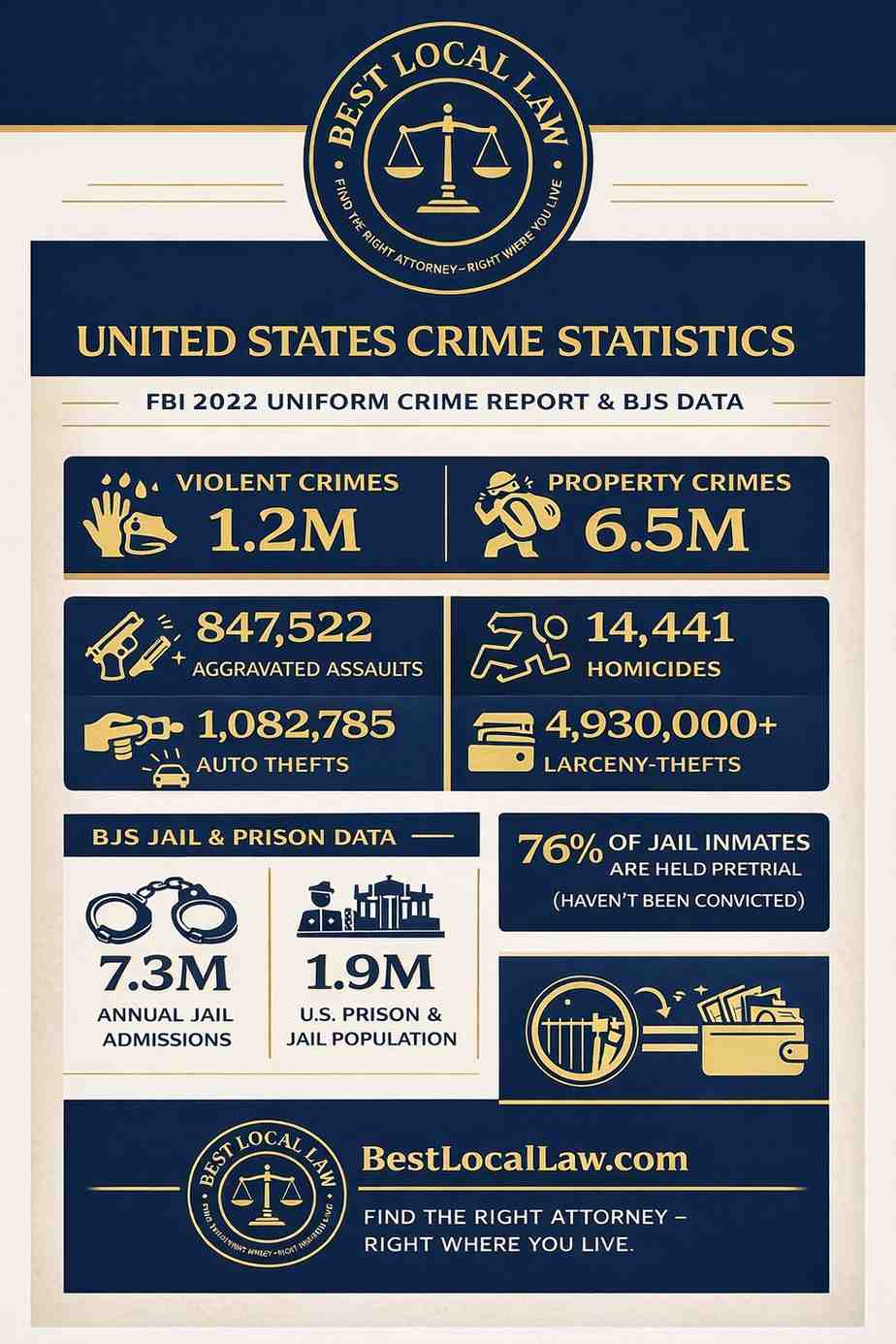
The FBI’s Crime in the Nation (2022) summary reported:
- Estimated violent crime offenses in 2022: 1,232,428 (rate 369.8 per 100,000 inhabitants).
- Estimated property crime offenses in 2022: 6,513,829 (rate 1,954.4 per 100,000 inhabitants).
- The same report notes that larceny-theft and motor vehicle theft increased from 2021 to 2022, with property crime overall increasing.
These numbers matter because they reflect what prosecutors see most often: property offenses (especially theft-related) dominate reported crime volume, while violent offenses—though fewer—carry the highest legal exposure.
Jail and incarceration realities (why arrest consequences are so immediate)
BJS data shows how many people are impacted by jails even before conviction. In the BJS “Jail Inmates in 2022” statistical tables:
- Local jails held 663,100 people in custody at midyear 2022. (Bureau of Justice Statistics)
- Jails reported 7.3 million admissions from July 2021 to June 2022, illustrating how many people cycle through custody even for short stays. (Bureau of Justice Statistics)
- BJS also reports that an estimated 76% (505,700) of the jail population was held for a felony offense at midyear 2022. (Bureau of Justice Statistics)
And in the BJS “Prisoners in 2022” summary tables:
- The imprisonment rate at year’s end 2022 was 355 sentenced prisoners per 100,000 U.S. residents (all ages). (Bureau of Justice Statistics)
The takeaway for someone facing arrest is practical: even before guilt is determined, detention can pressure outcomes, disrupt employment, and affect family stability. That is why early defense work (bail strategy, conditions, and motion practice) often determines the direction of a case.
The Long-Term Consequences of a Criminal Record
A criminal conviction is not just “what the judge orders.” Even a misdemeanor can trigger consequences that last longer than a sentence. The most common collateral consequences include:
- Employment: background checks, professional licensing restrictions, security clearance problems
- Housing: rental denials, public housing eligibility issues
- Education: program eligibility, internships, and professional school barriers
- Immigration: inadmissibility, deportation risk, loss of status for non-citizens (case-specific and high-stakes)
- Firearms rights: restrictions based on offense category and conviction history
- Family law: custody disputes and protective orders that affect parenting time
A pillar-page point that matters: many “quick pleas” are taken without fully understanding these consequences. A defense strategy should evaluate them before decisions are made.
Expungement and Record Sealing
While expungement and sealing are state-specific, the general concept is consistent: some outcomes allow a person to limit public access to records or remove them from certain background checks. Eligibility often depends on:
- The type of offense and outcome (dismissal vs conviction)
- Waiting periods
- Completion of probation or sentence
- No new cases during the waiting period
Because eligibility rules vary widely, this is a topic to discuss with counsel based on the actual case disposition.
Frequently Asked Questions About Arrests and Criminal Law
- What should I do immediately if I am arrested?
If you are arrested, remain calm, do not resist, clearly state that you are invoking your right to remain silent, and request an attorney. Do not answer investigative questions, do not consent to searches, and do not discuss your case with anyone except your lawyer. - What happens after I am arrested?
After arrest, you are typically taken to a detention facility for booking. This includes fingerprinting, photographs, documentation of charges, and system entry. You will usually appear before a judge for arraignment and bail determination within a short period, often within 24–48 hours, depending on jurisdiction. - How long can police hold me without charging me?
Generally, law enforcement must bring you before a judge within a limited timeframe, often within 48 hours of arrest, excluding weekends or holidays in some jurisdictions. The exact timeframe varies by state and federal law. - Do I have to answer police questions if I am innocent?
No. You have a constitutional right to remain silent regardless of guilt or innocence. Even innocent statements can be misunderstood, misquoted, or taken out of context. It is often safest to speak only through your attorney. - Can police lie to me during questioning?
In many circumstances, courts allow police to use deceptive tactics during interrogation, such as claiming they have evidence they do not actually possess. This is one reason invoking your right to counsel is critical. - What is probable cause?
Probable cause is a legal standard requiring specific facts that would lead a reasonable person to believe a crime occurred and that the suspect committed it. It is required for arrests and search warrants, but it is a lower standard than proof beyond a reasonable doubt. - What is the difference between a misdemeanor and a felony?
A misdemeanor generally carries up to one year in jail, while a felony typically carries a prison sentence exceeding one year. Felonies often have more severe long-term consequences. - Will my case go to trial?
Many criminal cases are resolved through plea negotiations before trial. However, if no agreement is reached, you have the right to a trial where the prosecution must prove guilt beyond a reasonable doubt. - What is bail, and how does it work?
Bail is a financial or conditional guarantee intended to ensure you appear in court. A judge may set monetary bail, impose supervision conditions, or release you on your own recognizance, depending on the severity of charges and your background. - Can charges be dropped before trial?
Yes. Charges can be dismissed if evidence is insufficient, witnesses are unavailable, constitutional violations occur, or prosecutors determine the case cannot be proven. Defense attorneys often pursue dismissal through investigation and motions. - What are my rights during a traffic stop?
You must provide identification and required documents, but you do not have to answer investigative questions about alleged wrongdoing. You may decline consent to search your vehicle, though officers may proceed if they claim legal justification. - What happens if I miss a court date?
Missing a court appearance can result in a bench warrant for your arrest and additional charges. Contact an attorney immediately to address the issue and attempt to resolve the warrant. - Can I clear my criminal record?
In some cases, expungement or record sealing may be available depending on the nature of the offense, the outcome of the case, and waiting periods. Eligibility varies by jurisdiction. - How does a criminal conviction affect employment?
Many employers conduct background checks. A conviction can limit job opportunities, affect professional licensing, and restrict access to certain industries, especially those involving trust, security, or vulnerable populations. - Do I need a lawyer if I plan to plead guilty?
Yes. Even if you believe pleading guilty is appropriate, an attorney can assess whether the charges are correct, negotiate better terms, evaluate collateral consequences, and ensure your rights are protected.
How a Criminal Defense Attorney Protects You
A pillar-page resource should explain what “real defense work” is, beyond “I’ll fight for you.”
In practice, an experienced criminal defense attorney will usually focus on six core areas:
1) Controlling early damage
The first goal is to stop the creation of evidence and protect the release conditions. That includes guiding communication (or non-communication) with the police and prosecutors and addressing bail promptly.
2) Evidence-driven investigation
Defense investigation is not just reading a police report. It may include:
- Witness interviews (before stories change)
- Video canvassing (business surveillance, doorbells, traffic footage)
- Phone and digital data preservation
- Scene analysis and timeline reconstruction
3) Constitutional litigation
Suppression motions can be case-changing. If a stop, search, or interrogation was unlawful, evidence can be excluded, reducing charges or ending the case.
References
Federal Bureau of Investigation – Crime in the Nation, 2022
https://cdn.factcheck.org/UploadedFiles/UCR_Crime_in_the_Nation_2022.pdf
Federal Bureau of Investigation – Crime Data Explorer
https://cde.ucr.cjis.gov/
Bureau of Justice Statistics – Jail Inmates in 2022
https://bjs.ojp.gov/document/ji22st.pdf
Bureau of Justice Statistics – Prisoners in 2022
https://bjs.ojp.gov/document/p22st_sum.pdf